Essay Writing
A step-by-step guide to writing essays that are clear, well-structured, and persuasive. Learn the framework, then use RewriteMate to polish your draft in any app.
AI keyboard for iOS and macOS. Free to try.
The Hidden Friction in Student Mobile Workflows
Inspiration hits anywhere—on the commute, in a library alcove, or between classes. Yet, turning those fragmented thoughts into a coherent academic paper on a phone or tablet is notoriously challenging. Traditional workflows force you to write a rough sentence in Google Docs, select it, copy it, leave your document, launch a browser tab or a standalone AI app, paste it, choose a preset option, and copy the outcome back.
This constant context-switching fragments your focus and breaks your analytical flow. The problem isn't your capability; it’s the rigid layout of standard mobile writing tools that isolate text generation from the typing surface.
The Standard Essay Structure
Most essays follow a five-paragraph structure. This works for academic essays, college applications, and persuasive writing.
Introduction
Hook the reader, introduce your topic, and end with a clear thesis statement that states your main argument.
Body Paragraph 1
Your strongest point. Start with a topic sentence, provide evidence or examples, and explain how it supports your thesis.
Body Paragraph 2
Your second strongest point. Same structure — topic sentence, evidence, explanation. Use a transition word to link from the previous paragraph.
Body Paragraph 3
Address a counterargument or provide additional support. Show you have considered other perspectives.
Conclusion
Restate your thesis in fresh words. Summarize your main points. End with a thought-provoking final sentence.
Writing a Strong Thesis
Your thesis is the central argument of your essay. A strong thesis is specific, debatable, and focused.
Weak: Social media has both positive and negative effects.
Strong: While social media connects people across distances, its deep impact on youth mental health and fragmented digital productivity requires conscious, systemic boundaries.
The strong thesis takes a explicit position, acknowledges structural nuance, and implicitly outlines the essay's evolutionary structure.
Before vs. After: Refining Academic Tone
Writing academically requires transitioning from an conversational stream-of-consciousness to assertive, precise prose. See how messy thoughts transform when polished for academic expectations:
I think Shakespeare wanted people to see that Romeo and Juliet weren't really just totally in love, but they were acting super crazy because of how their families hated each other and stuff.
Shakespeare demonstrates that Romeo and Juliet’s intense passions are less indicative of pure romance than they are a volatile psychological reaction catalyzed by their families’ systemic animosity.
The experiment worked out great and the numbers showed that when the temperature went way up, the enzymes stopped doing what they usually do and basically died.
The experimental results indicate that elevated thermal levels induce severe protein denaturation, rendering the target enzymatic structures completely non-functional.
Custom AI Shortcut Prompts for Student Workflows
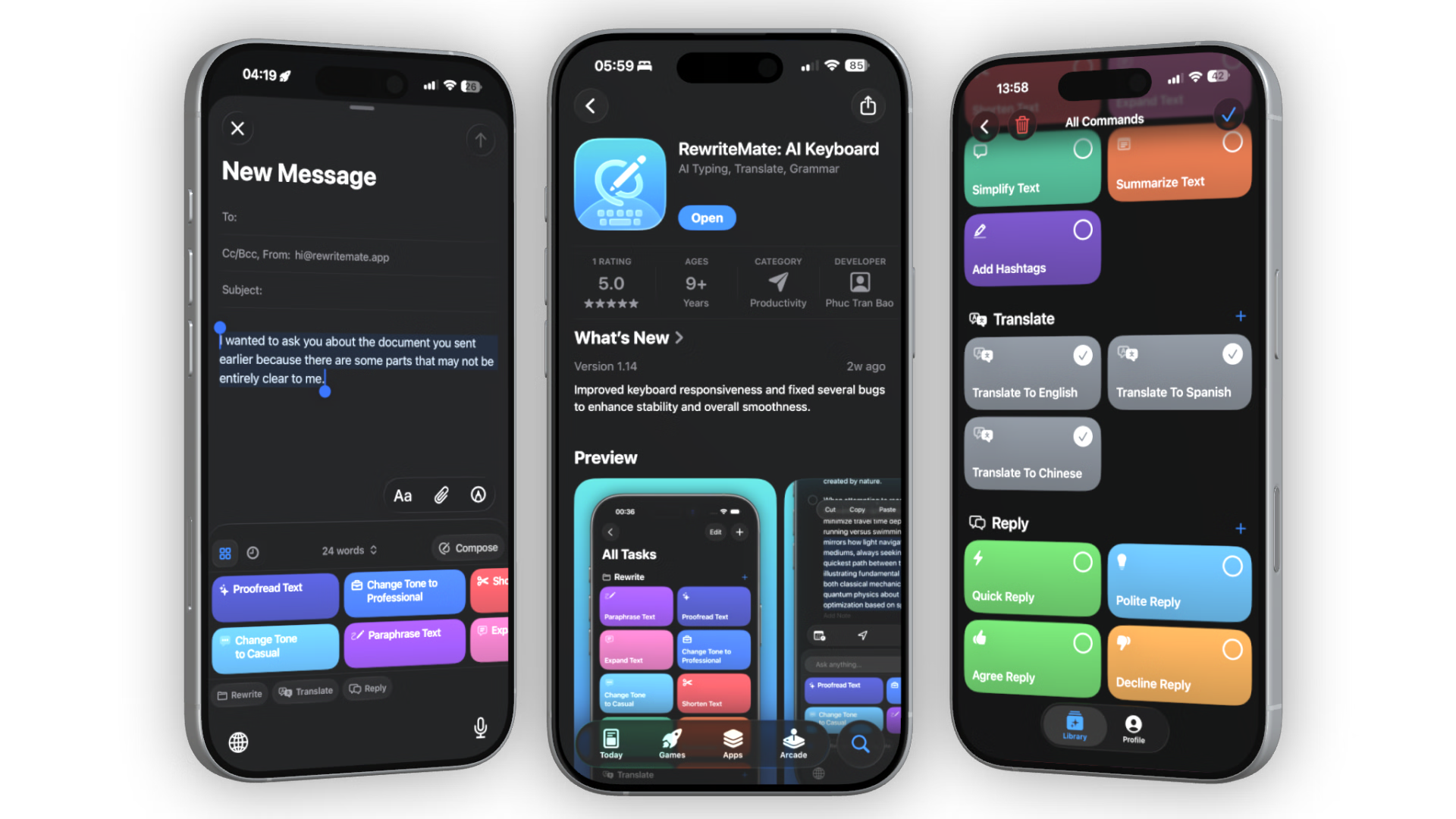
While basic AI tools limit you to generic presets like "Make Formal," advanced tools allow you to configure custom macros. By pinning targeted commands right onto your keyboard, you eliminate writer's block immediately within Pages, Word, or Google Docs.
"Analyze my sentence and insert a transition phrase followed by a viable academic counterargument that should be addressed."
"Rewrite the selected phrase to seamlessly blend the raw textual quote into an assertive, analytically objective statement."
"Condense this specific body paragraph into a singular, impactful summary sentence suitable for an analytical conclusion."
Editing Your Essay
Read aloud
Reading your essay out loud helps you catch awkward phrasing and run-on sentences.
Check transitions
Each paragraph should flow naturally to the next. Use transition words like however, therefore, and furthermore.
Cut weak words
Remove very, really, quite, and thing. Replace them with precise language.
Verify your thesis
Every paragraph should support your thesis. If a paragraph doesn't, cut it or revise your thesis.
Polish Your Essay with AI
RewriteMate helps you paraphrase, proofread, and improve your essay — directly inside Notes, Pages, Google Docs, or any app on your iPhone or Mac.
Download RewriteMate FreeData Security & Privacy for Academic Integrity
Academic environments demand absolute data integrity and rigorous adherence to institutional privacy benchmarks. When utilizing an AI keyboard extension for line editing, understanding your data's footprint is vital.
Zero-Retention Parsing
Your essay content is processed exclusively on demand to compute the specific rewrite instruction. Text fragments are never saved, cached, or permanently stored.
Keystroke Isolation
Unlike classic predictive extensions, your passive everyday typing is completely untouched. The engine only activates when you manually select a text block and trigger a specific action.
Frequently Asked Questions
What is the five-paragraph essay?▾
A standard structure with an introduction, three body paragraphs, and a conclusion. It works well for timed essays and provides a clear framework for organizing ideas.
How do I write a thesis statement?▾
A thesis statement should make a specific claim that you will support in your body paragraphs. It usually appears at the end of your introduction.
Can RewriteMate help me write my essay?▾
RewriteMate helps you improve what you have already written. Use it to proofread, paraphrase, adjust tone, or expand on ideas — directly inside your writing app.
Is RewriteMate free for students?▾
Yes. RewriteMate has a free tier with powerful rewriting and proofreading commands. Students can upgrade to Pro for unlimited use and custom commands.
Does the keyboard require full access to log keystrokes?▾
No. While the extension requests standard system permissions to send selected text snippets to the AI models, it has a strict zero-retention architecture. It never tracks passwords, credit cards, or logs background typing data.
Can I choose which AI models process my essay?▾
Yes. In the main companion app dashboard, you can configure your backend preferences, manage customized essay macros, or leverage the Bring Your Own Key (BYOK) framework to route tasks through your own API limits.