
September 16, 2026
How to Say No to More Work Professionally Over Text
How to Say No to More Work Professionally Over Text
To say no to extra work professionally, state your current priority, name the trade-off, and ask the requester to help choose what should move. You do not need a long apology or a detailed defence of your calendar.
The best boundary is clear enough for the other person to act on. Asana recommends considering when a decline is appropriate and offers practical phrasing for setting work boundaries; Emily Post similarly suggests naming your top responsibilities when you cannot take on more. Asana’s guide and Emily Post’s advice are useful references.

Use the priority, limit, and choice structure
- Priority: State what you are currently responsible for.
- Limit: Explain that adding the new task would affect that commitment.
- Choice: Offer a realistic alternative, delayed start, or prioritisation question.
I am focused on completing [current priority] by [date]. I cannot take on [new request] as well without moving that deadline. If this is now the higher priority, could you confirm what you would like me to defer?
This is more useful than “I am too busy.” It shows the actual decision that needs to be made.
Messages you can adapt
When a teammate asks for help today
I can help with this after I finish [current task] on [date]. If it needs to happen today, could we agree on which of my current priorities should move?
When a manager assigns another task
I am currently committed to [A] and [B] for this week. I can take on [new task], but I will need your guidance on which item should be deprioritised so I can deliver the right work well.
When the request is outside your capacity
Thanks for thinking of me. I do not have capacity to take this on by [date] without affecting existing commitments. I can start on [realistic date], or I can share [limited help] today if that is useful.
When you need an after-hours boundary
I am offline for the evening and will review this tomorrow. If it is urgent, please use [approved escalation path].
Do not promise an alternative person, deadline, or escalation path unless you know it is available.
Avoid these common mistakes
| Avoid | Why | Better move |
|---|---|---|
| “I cannot do this.” | Leaves no path forward. | Name the trade-off or a realistic start date. |
| A long personal explanation | Invites debate about your reasons. | Keep the focus on work and capacity. |
| “Sure, I will try.” | Creates an unclear commitment. | Ask for priority guidance. |
| “That is not my job.” | May be true but can escalate tone. | Ask how it fits with current priorities. |
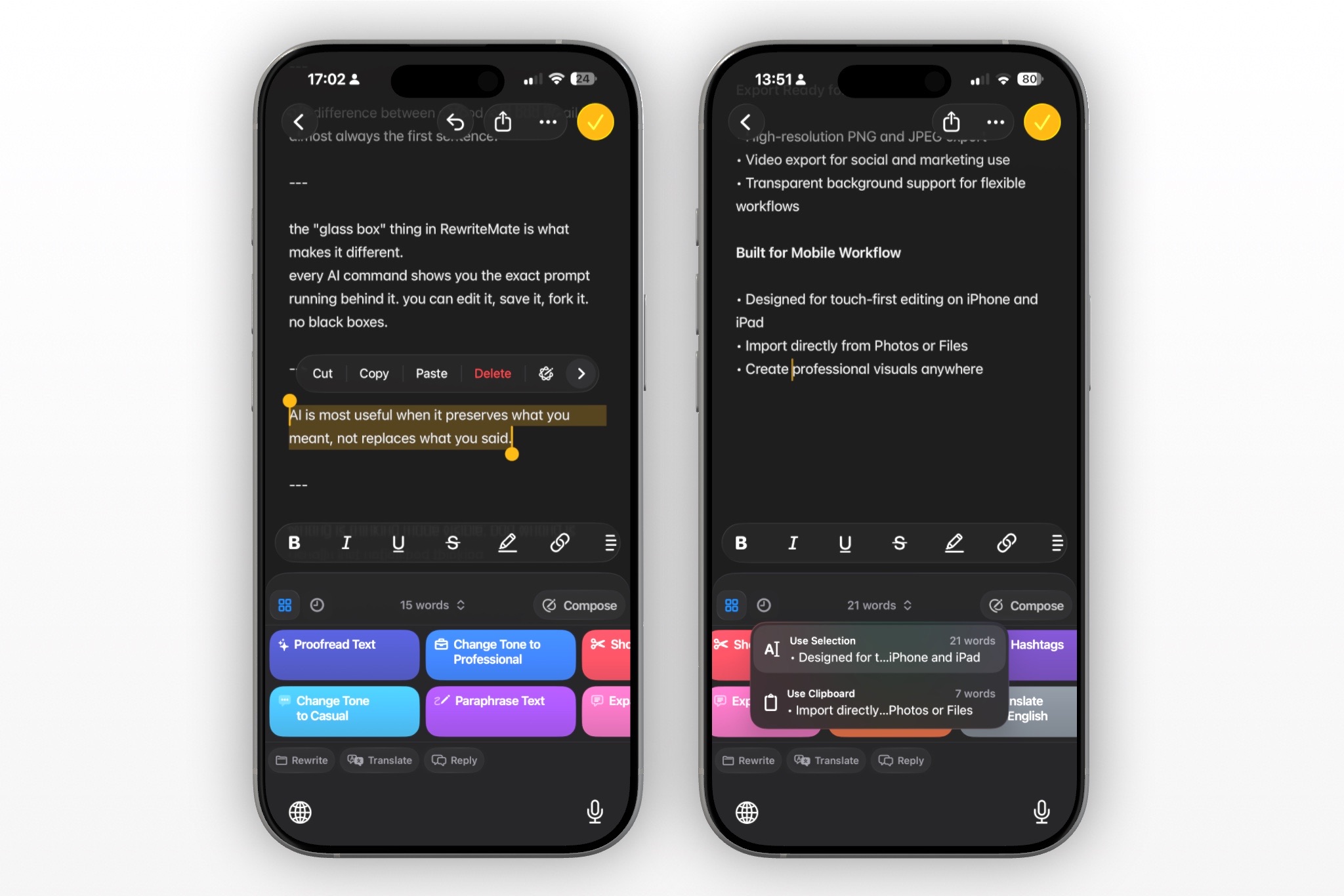
Turn it into a RewriteMate command
- Command name: Professional Work Boundary
- Folder: Work Messages
- Output action: Copy
Rewrite this as a concise, respectful work boundary. Preserve all names, dates, priorities, and stated facts.
Explain the capacity limit without apology or blame. Offer only alternatives explicitly provided in the input, or ask one clear prioritisation question.
Do not invent deadlines, staffing, commitments, or escalation paths.
Review the priority, deadline, and any alternative before sending. RewriteMate can help make the message clear; it cannot decide what your manager should deprioritise.
Frequently asked questions
Is it unprofessional to say no to extra work?
No. A professional response makes the workload trade-off visible and helps the team choose priorities deliberately.
Should I apologise when I set a boundary?
Use an apology when you missed a commitment. For a capacity boundary, clarity and respect are more useful than repeated apologies.
How do I say no to my manager?
Do not frame it as refusing all work. Explain what is already committed, then ask which priority should move if the new task is more important.
Can I set a boundary over text or Slack?
Yes, if the topic is straightforward. For a complex disagreement or sensitive workload issue, ask for a conversation instead.
Write better everywhere
Rewrite, rephrase, and refine text instantly without switching apps.
Related articles
Keep reading

How to Tell a Client You Need More Time Professionally
A clear way to request more time from a client without making excuses, overpromising a new date, or leaving the next step unclear.

How to Reply to an Email Professionally From Your iPhone
Write clear, professional email replies from your iPhone with a simple structure, practical examples, and AI-assisted editing tips that keep your message accurate.

Felix Tran
RewriteMate Dev & Editorial Lead
Write about everyday workflows, systems that help ideas move faster, from first draft to finished work.